Confirming peptide identity plays a critical role in biopharmaceutical quality control, biosimilar development, and proteomic research.
Regulatory agencies require robust analytical evidence to verify protein sequence integrity, detect post-translational modifications, and confirm consistency across manufacturing batches.
Mass spectrometry serves as a primary analytical tool in these activities and appears in more than 99 percent of FDA Biologics License Applications for therapeutic proteins.
Traditional protein analysis techniques, such as SDS PAGE, isoelectric focusing, or UV detection, provide limited structural detail and lack sequence specificity. Mass spectrometry delivers high resolution, high throughput, and sequence-specific information.
Modern peptide mapping workflows routinely achieve greater than 95 percent sequence coverage, enabling confident verification of primary structure and structural attributes.
Fundamentals of Peptide Mapping

Peptide mapping serves as a foundational analytical strategy for confirming protein primary structure in regulated and research environments.
Analytical confidence relies on controlled protein digestion, reproducible separation, and precise mass analysis.
Combined results create a detailed structural profile that supports identity confirmation and structural integrity assessment.
Peptide mapping represents a systematic approach for characterizing protein primary structure through enzymatic digestion, chromatographic separation, and mass spectrometric analysis.
Digestion produces predictable peptide fragments that act as molecular fingerprints.
Comparison of experimentally observed peptide profiles against theoretical sequences confirms protein identity and verifies sequence integrity.
Site-specific insight into post-translational modifications, such as oxidation, deamidation, or glycosylation, becomes accessible through peptide mapping workflows.
Therapeutic antibodies generate complex peptide patterns after digestion. Herceptin digestion yields approximately 62 peptides that collectively confirm sequence coverage and modification status.
Enzymatic Digestion
Controlled enzymatic digestion defines peptide mapping quality.
Proteolytic enzymes cleave proteins at known amino acid residues, producing reproducible peptide sets that enable confident sequence assignment.
Digestion efficiency directly affects coverage, chromatographic resolution, and downstream identification accuracy.
Proteases differ in cleavage specificity and operational conditions, allowing tailored digestion strategies for complex proteins.
Commonly applied enzymes include:
- Trypsin, cleaving at lysine and arginine residues
- Chymotrypsin, cleaving at phenylalanine, tyrosine, and tryptophan
- Asp N, targeting aspartic acid and glutamic acid
- Pepsin, active under acidic conditions and favoring hydrophobic residues such as leucine and phenylalanine
- Lys C, cleaving selectively at lysine residues
Protease selection influences peptide length and sequence coverage.
Myozyme digestion with Lys C generates fewer and larger peptides compared with trypsin digestion, resulting in altered chromatographic behavior and different sequence resolution patterns.
Sample Preparation Techniques
Sample preparation quality strongly influences mass spectrometric performance and data reliability.
Improper handling introduces contaminants, suppresses ionization, and creates analytical artifacts that complicate interpretation.
Removal of interfering substances improves spectral clarity and signal intensity.
Effective cleanup strategies include dialysis, gel filtration, and solid phase extraction, all supporting desalting and buffer exchange to eliminate non-volatile salts.
Protein denaturation enhances digestion efficiency and structural accessibility.
Reduction and alkylation disrupt disulfide bonds through a controlled chemical process that includes:
- Dithiothreitol reduction of cysteine disulfide bridges
- Iodoacetamide alkylation to prevent bond reformation
Targeted enrichment improves the detection of low-abundance modified peptides. Phosphopeptide and glycopeptide enrichment strategies increase sensitivity and improve modification site characterization.
Iron Peptides manufactures USA-made, lab-tested peptides with verified 99%+ purity, supporting research applications that rely on analytical methods like HPLC and MS for quality control and identity confirmation.
Mass Spectrometry in Protein and Peptide Analysis

Mass spectrometry forms the analytical backbone of peptide mapping workflows. Measurement of mass-to-charge ratios enables the precise determination of peptide composition and structural features after ionization.
Ionization converts peptides into gas-phase ions while preserving structural information.
Electrospray ionization performs effectively for peptides and proteins, producing multiply charged ions that reduce mass range constraints and enhance fragmentation efficiency.
Matrix-assisted laser desorption ionization generates predominantly singly charged ions and supports analysis of large biomolecules, though glycoprotein analysis remains limited.
Tandem mass spectrometry provides sequence-level confirmation through controlled fragmentation.
Fragmentation approaches generate diagnostic ions that encode amino acid order and modification placement:
- Collision-induced dissociation producing b and y ions
- Electron transfer dissociation preserving labile modifications
- Electron capture dissociation improves the fragmentation of large peptides
Data Acquisition Modes
Acquisition strategy determines analytical depth and quantitative reliability. Different modes support discovery, confirmation, or targeted quantitation depending on analytical goals.
Full scan acquisition captures all ions across a defined mass range, supporting global profiling.
Data-dependent acquisition selects high-intensity precursor ions for fragmentation, enabling peptide identification during discovery workflows.
Data-independent acquisition fragments all ions within predefined mass windows. Widely used targeted and semi-targeted approaches include:
- SWATH for comprehensive fragment coverage
- PRM for high specificity peptide monitoring
- MRM for regulated quantitative assays
Integration With Chromatography
Chromatographic separation reduces sample complexity prior to mass analysis and improves identification confidence. Liquid chromatography coupled with mass spectrometry remains standard for peptide mapping workflows.
Reversed phase LC separates peptides based on hydrophobicity. Digest chromatograms often display more than 100 distinct peptide peaks.
Column chemistry selection affects resolution and selectivity, with commonly applied options including C18, phenyl hexyl, and superficially porous materials.
Hydrophilic interaction chromatography improves the retention of small or polar peptides that elute poorly during reversed-phase separation.
NanoLC and UHPLC platforms enhance ionization efficiency and sensitivity, supporting proteomics applications and the detection of low-abundance peptides.
Confirming Peptide Identity

Analytical confirmation of peptide identity requires multiple layers of evidence.
Combined mass accuracy, fragmentation data, and database alignment ensure confident sequence verification.
Sequence Confirmation
Peptide mass fingerprinting compares observed peptide masses against theoretical values calculated from known protein sequences.
Tandem mass spectra provide fragment ion patterns that confirm amino acid order.
Quality metrics used for confirmation include:
- Low parts per million mass error
- Extensive sequence coverage across protein length
- Accurate matching to curated protein databases such as UniProt
- Integrated evidence supports confident peptide and protein identification.
Post Translational Modifications
Post translational modifications introduce predictable mass changes that enable detection and localization. Common modifications produce characteristic shifts that guide interpretation.
Observed mass changes include oxidation at plus 16 daltons, deamidation at plus 1 dalton, phosphorylation at plus 80 daltons, and variable increases associated with glycosylation.
LC MS MS enables site specific localization of modified residues.
Quantitative assessment relies on extracted ion chromatograms comparing modified and unmodified peptide forms.
Enzymatic deglycosylation with PNGase F converts asparagine to aspartic acid, producing a 1 dalton shift that reveals glycosylation site occupancy.
Molecular Mass Determination
Intact protein analysis complements peptide-level data. Top down mass spectrometry analyzes proteins without digestion, providing accurate molecular mass measurement.
Intact mass analysis detects terminal truncations, sequence variants, and glycoform heterogeneity.
Glycoform distributions appear as repeating mass differences of 162 daltons per hexose unit.
The distinction between monoisotopic and average mass becomes increasingly important for large proteins such as monoclonal antibodies.
Challenges and Considerations
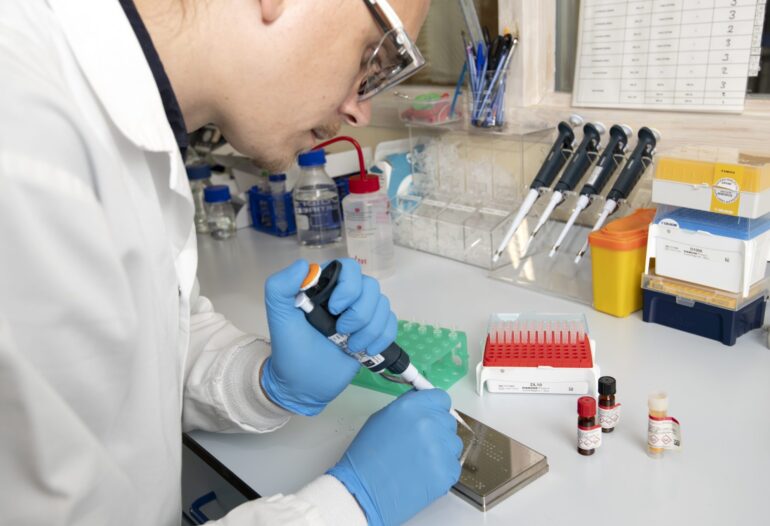
Analytical limitations influence data quality and interpretation.
Matrix effects reduce ionization efficiency due to salts or detergents such as Tween 80.
Sample preparation artifacts introduce artificial oxidation or deamidation during digestion.
Modified peptides, particularly glycopeptides, ionize poorly.
Deglycosylation improves detectability. Leucine and isoleucine share identical mass values, requiring advanced fragmentation techniques such as EThcD for differentiation.
Large datasets demand experienced analysts and validated software pipelines to prevent false identifications.
Regulatory and Industrial Relevance
Mass spectrometry plays a central role in biosimilarity assessment, lot release testing, stability studies, and comparability evaluations following manufacturing changes.
Regulatory submissions for therapeutic proteins rely extensively on MS-based evidence.
Industry reviews report mass spectrometry usage in approximately 100 percent of approved Biologics License Applications.
Regulatory expectations continue to reinforce mass spectrometry as a standard analytical requirement across biopharmaceutical development and quality control.
The Bottom Line
Mass spectrometry combined with peptide mapping enables high-confidence confirmation of peptide and protein identity. Sequence verification, post-translational modification detection, and molecular mass determination support product quality and consistency.
Advances in ionization methods, chromatographic integration, and data analysis reinforce mass spectrometry as a central analytical platform for proteomics and biopharmaceutical development.